

Taking Up Space: A Personal Review of Sonya Renee Taylor’s Book, Your Body Is Not An Apology
“Radical self-love is not a destination you are trying to get to; it is who you already are...”
—Sonya Renee Taylor
I was seven when I first wondered if my thighs were too big. I have a memory of being outside at recess during grade school, sitting on a bench, picking up my thigh, my muscle falling, succumbing to gravity, making my thigh look thinner.
That was how I wanted my thighs to look. I’d set my leg down, muscles spreading out, and resolve that my thighs were indeed “fat”. I was in the second grade, my mind marinated in my mother’s harsh words about her body, causing me to question the worthiness of my own.
One evening, for an unknown reason, I was on the floor of my grandmother's kitchen, outwardly upset about the size of my thighs. My stepdad, a rough, authoritarian man, reprimanded me so harshly that I felt in trouble more than given compassion or shown curiosity for how I was feeling. Ironically, he was the one who compared my body to the Olsen twins, he was the one who commented on my body when it was changing, and he was the one who touched my body in a way a grown man never should.
(Perhaps this was when I learned to apologize for the existence of my body. Perhaps apologizing for the existence of my body was inevitable because of my brownness and my femininity. Perhaps the seed of body-hatred was planted long, long before.)
My desire to shrink was both to be physically small and to go unnoticed, not taking up physical space. By late adolescence, my eating was incredibly disordered. Meanwhile, family members praised and coveted my thinness. When I wanted to diet to get thin for prom, my mom offered to join in, further underlining in my mind that chasing smallness is a virtue. This message translated into the present way I do or don’t use my voice; communicating from the depth of my nine-year-old self that I “should” be quiet, docile, even-tempered, never loud, never experiencing the range of rage.
According to the cult I was indoctrinated by, how I dressed could cause men to stumble because, somehow, I was responsible for another human's actions and thoughts.
So, reading Sonya Rene Taylor’s book, The Body is Not an Apology, caused me to reflect on these subliminal messages and memories. The intersection of our bodies (race, color, ability, etc.) makes not apologizing for them hard, and still, in the same breath, we must take up space, becoming unapologetic in the way our body looks, how our body feels, our self-expression through what we wear (or don’t), the space our body and mind take up, and the way we move through the world around us.
While one might assume body image is limited to fat, thin, pretty, ugly, it’s also all the other intersections of bodies in general. Brown bodies, able bodies, Black bodies, white bodies. She illustrates this in her analogy of a ladder.
The ladder represents the idea that some bodies are valued more than others, and individuals are often judged and ranked based on their physical appearance, with those at the top of the ladder considered more desirable and those at the bottom facing discrimination and marginalization. She argues that this ladder is a harmful construct that perpetuates body shame, inequality, and discrimination. Something eye-opening, Taylor explains, is that the ladder isn’t leaning up against systems of oppression; it is the system of oppression. If we don’t participate, the system does not exist.
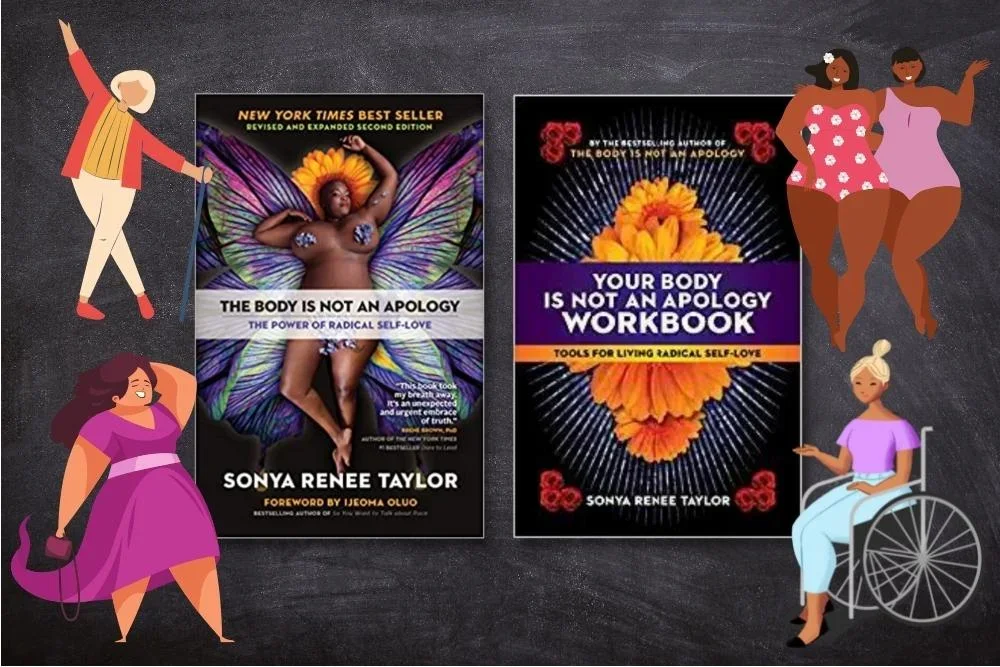
The entire book is a powerful exploration of the relationship between self-acceptance, body image, and social justice. Taylor, through her beautiful prose, delves into the intersections of body image, race, gender, and disability, highlighting the importance of recognizing and challenging systemic inequalities that perpetuate negative body image. Overall, this book challenged me to look at ways I judge bodies, mine and others, and reminded me that radical self-love is a practice and a returning again and again.
